CTRL’ing AI: Under the hood and beyond the hype
Estimated reading time: 5 minutes
While ChatGPT has been grabbing the headlines, a different kind of AI has been quietly transforming student outcomes for a decade. Let’s take a look at the difference between Generative AI and Non-Generative AI to understand how we can really personalise learning with AI.
In the wake of the AI boom, the term “Artificial Intelligence” has become a catch-all phrase for everything from chatbots to automated grading systems. Associated tools have been flooding the market, promising lower teacher workload and improved outcomes. School leaders are increasingly expected to be the gatekeepers, evaluating which tools are beneficial for the classroom and which should be avoided.
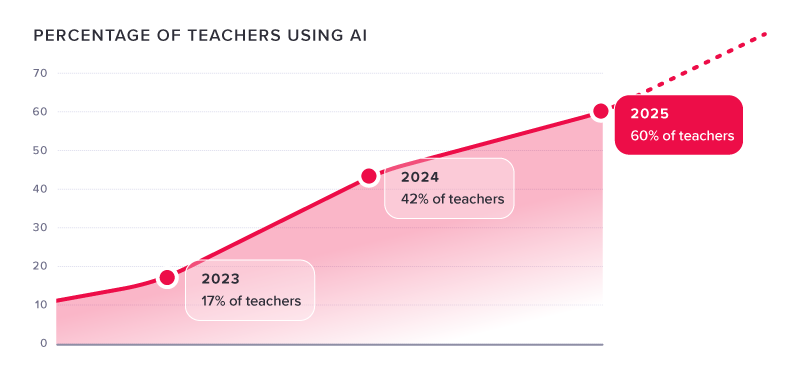
What is Generative AI and How Does it Impact Education?
As the name suggests, Generative AI is designed to generate new content – whether that’s text, code, images or audio – in response to user input. In schools this ranges from tools promising to create all your lesson plans in minutes, to student-facing chatbots that cause existential questions about the role of homework!
So how does Generative AI actually work? We’ll talk about Large Language Models (LLMs) in this section, but the same process applies to other types of generative tools.
How Machines “Understand” Your Prompts
For a LLM to process a prompt, it must transform words into word embeddings—a series of numbers called vectors.
"Pen": [1.5, -0.4, 7.2, 19.6, 20.2]
"Pencil": [1.7, -0.3, 6.9, 19.1, 21.1]
"Bus": [81.6, -72.1, 16, -20.2, 102]
In human language, words have meanings and we can group words based on those meanings. In the example above, “pen” and “pencil” are similar, and “bus” is not. The word embeddings not only allow the machine to process the word, they also represent the similarity between words through the similarity of the numerical sequences. Imagine that we plotted the individual coordinates of each work on a mathematical graph. The coordinates for “pen” and “pencil” would sit near each other, while “bus” would be far away, telling the model that the first two are similar in meaning.
While this is effective for the relationships between individual words, the model will not be able to generate coherent and useful responses with just word embeddings. We need to add two more components to our model:
- Self-attention mechanisms: In the sentence “The animal didn’t cross the street because it was too tired,” self-attention tells the machine that “it” refers to “the animal”, providing the context necessary for coherent text generation.
- Human-in-the-loop: This step filters coherent responses from the model into genuinely useful responses. Human “labellers” are given multiple outputs from the model, which they rank in quality to train (teach) the AI which responses are high-quality.
At this point, we have a functioning tool with some classroom value: Ask it to write you an algebra question, or to give you an example of persuasive writing for your students to analyse, and you may well get something usable.
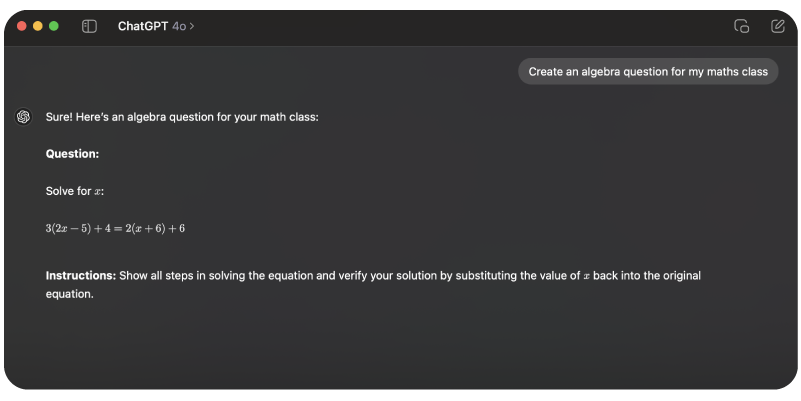
But there is still a long way between this and fundamentally transforming our classrooms.
Why Context is Key to Classroom Utility
While an out-of-the-box LLM can write a generic algebra question, it lacks the specific context of your classroom: for example that you’re teaching the IGCSE specification, what year your students are in, what your students already know.
Unless we tell the LLM our context, it can’t integrate this into the output.
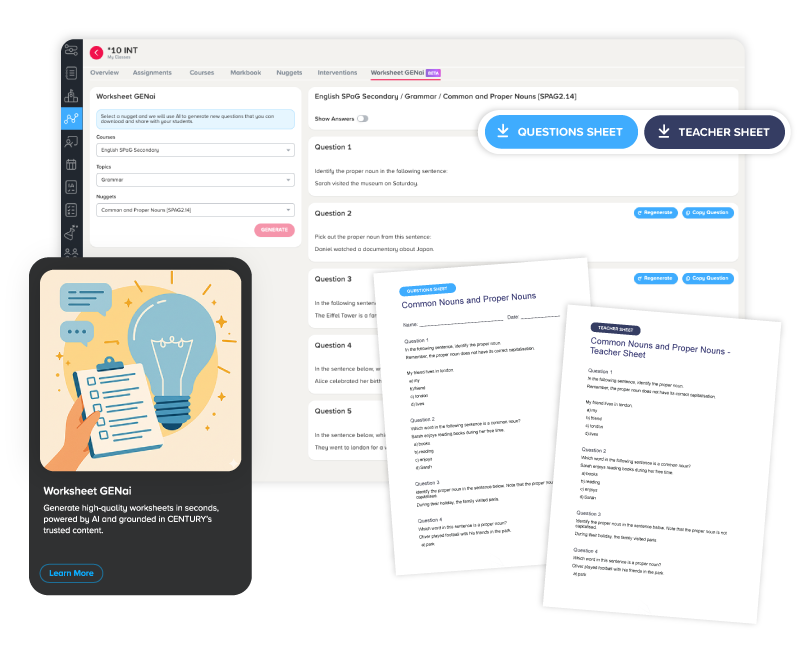
To be transformational, Generative AI needs a context window. For example, Worksheet GENai in CENTURY was built to generate worksheets based on all the relevant content created in CENTURY. To generate an iGCSE algebra quiz we retrieve all the relevant information from the CENTURY iGCSE maths course (video transcripts, subtopics covered, existing questions, difficulty level) and give this to an LLM to generate a quiz that is grounded in safe, accurate content.
Non-Generative AI: Uncovering Insights Through Deep Connections within Data
For higher-stakes tasks like predictive recommendations or automated grading, Generative AI is often the wrong tool. Whilst we can expand the context windows within Generative AI by providing highly granular data alongside our prompts, this isn’t enough to enable reliable predictions.
For these types of tasks we need a tool that excels at finding patterns in data: Non-Generative AI (often called Classical Machine Learning).
Actionable Intelligence to Personalise Learning at Scale
AI can personalise learning at scale, but to do so it needs the right data.
For truly transformative personalisation of learning, we need to take historic learning data for an individual student, cross reference this with data about the curriculum and then produce a recommendation for what the next activity for that student should be. An example of this is CENTURY’s Recommended Pathway.
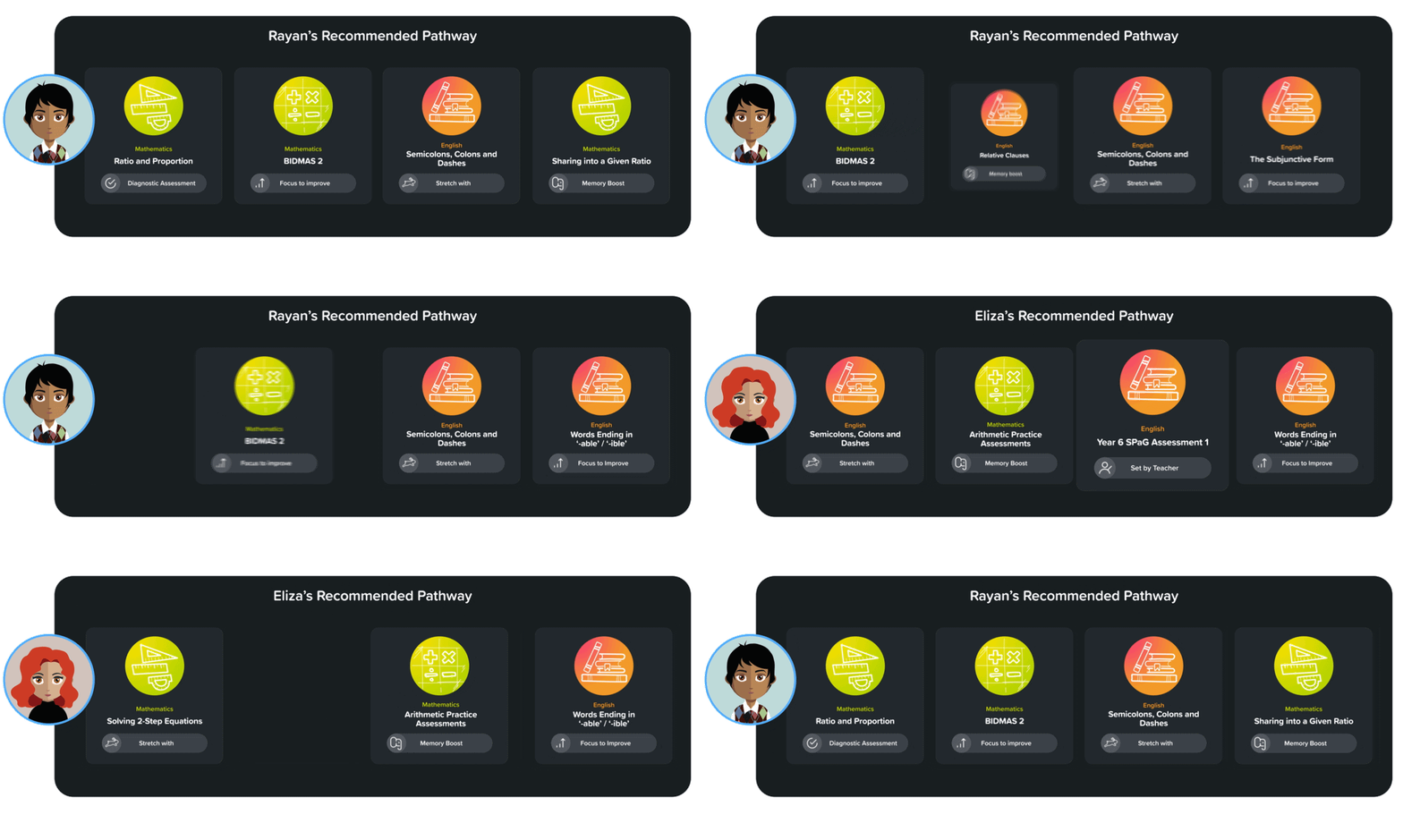
Underpinning the Recommended Pathway is a Knowledge Tracing model. To provide the model with the historic learning data and the curriculum data, we built two data graphs:
- The User Activity Graph: Captures every student interaction, including question responses, time spent, navigation patterns, and how well they have learned a concept so far.
- The Content Graph: Captures the non-linear, complex relationships between learning topics (e.g., how “Percentage of an Amount” relates to “Compound Interest”).
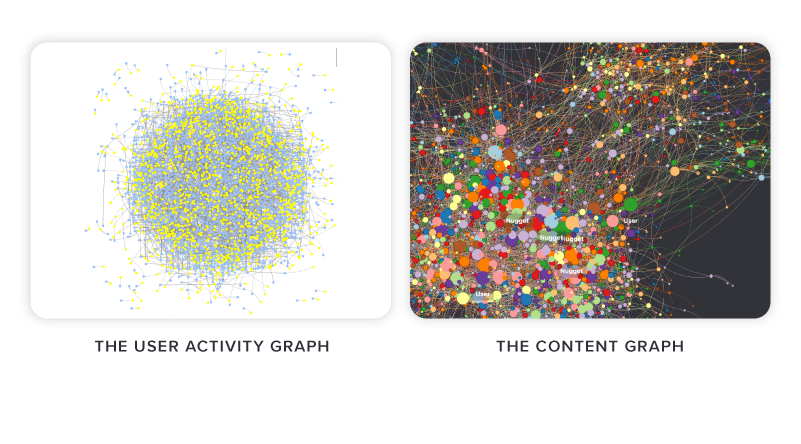
Combined, these graphs contain billions of data points. The knowledge tracing model analyses the graphs for patterns and uses these to predict how likely a student is to succeed in their next step. These predictions are used by the recommendation engine to select content for the Recommended Path which pushes a student forward when ready or provides support when they struggle.
The Recommended Pathway, underpinned by the Knowledge Tracing model, transforms learning into a truly personalised experience.
Conclusion: Bridging the Gap Between Technology and Pedagogy
Understanding the distinct roles of Generative and Non-Generative AI is the first step toward using these tools effectively in the classroom. While Generative AI (coupled with the appropriate context windows) serves as a powerful content engine, it is Non-Generative AI that provides the analytical depth required for true educational transformation.
By harnessing the actionable intelligence that arises from non-generative tools, educators can move beyond a one-size-fits-all approach. Ultimately, when these tools are grounded in high-quality content, real classroom data and teacher expertise, they serve to enhance the most critical element of any classroom: the impact of the teacher on their students.
To learn more about CENTURY, reach out to our team and book a free demo of the platform today.
CENTURY in the news
View all News
-

News
19th March 2026
Macmillan Education and CENTURY Announce Strategic Partnership to Transform Phonics Learning
Macmillan Education and CENTURY have announced a landmark partnership, combining their expertise to support learners and teachers worldwide. By harnessing Macmillan Education’s heritage in high-quality resource design and CENTURY’s expertise in building innovative technology, the two organisations are uniquely placed…
Read more
-
News, Blog
17th February 2026
CENTURY Joins The Tutors’ Association
CENTURY Tech joins The Tutors’ Association (TTA). Discover how our AI powered teaching, learning and assessment platform supports tutors with personalised pathways and data-driven insights.
Read more