Baseline Assessments: Building a Stronger Starting Point for the School Year
Estimated reading time: 7 minutes
Every September, teachers meet a class they don’t fully know yet. Some pupils are entirely new to the school; others have simply moved up a year, but either way, there is a gap between the general sense of a class a teacher can reasonably form in the first few days and a clear picture of what these particular pupils currently know and can do.
A baseline assessment helps close that gap. It gives teachers and leaders a consistent starting point from which to plan teaching, identify gaps and decide where support may be needed. No assessment can substitute for the judgement a teacher develops through the year, but it can provide useful evidence before that picture has fully formed. For school and trust leaders, that evidence becomes particularly valuable when it can be viewed consistently across classes, year groups and schools.
What good baseline data tells school and trust leaders
For a headteacher or trust leader, baseline assessment helps answer a fundamental question: how are we doing, and compared to what?
A good baseline assessment gives leaders an early picture of where pupils are starting the year academically. At pupil level, it can identify areas of strength and gaps that may need attention. At class and year-group level, it can show patterns in attainment that are difficult to see from individual pupils alone. Across a trust, consistent assessment can give leaders a common view of attainment across schools.
The value of this consistency is important. A teacher’s assessment of a class can be highly useful for that teacher, but it is not necessarily designed to travel. One teacher’s definition of a “secure understanding” may not match another’s, even within the same school. Putting different sets of teacher judgements side by side across year groups or schools therefore does not necessarily produce a meaningful comparison.
A baseline assessment gives schools a common framework for understanding where pupils are starting from. The more consistently that assessment is designed, administered and interpreted, the more useful the resulting evidence becomes. Standardised and benchmarked assessments add another layer of insight by allowing leaders to place pupils’ attainment against a wider reference group. That can help leaders see where whole year groups sit in relation to a national reference point, where attainment gaps may be concentrated, and whether the starting point of one cohort differs from previous cohorts. For trust leaders, consistent assessment across schools can also help identify where attainment patterns are similar or different and where there may be practice worth sharing or additional support worth providing.
At pupil level, baseline data can help leaders identify pupils who may be furthest from the expected standard early in the year, rather than waiting for the first set of formal results before deciding where additional support may be needed.
Transition from primary to secondary is where the value of a current starting point can become particularly visible. A DfE-commissioned survey found that just 24% of secondary teachers agreed that KS2 SATs results gave them useful information for identifying which incoming Year 7 pupils needed support, compared to 53% who disagreed. Commenting on these findings, the Association of School and College Leaders has called the purpose of the SATs tests “muddled”.
For a secondary leadership team, a baseline assessment can therefore provide a useful additional source of evidence about the Year 7 cohort in front of them, rather than relying solely on attainment data collected several months earlier.
What a baseline assessment can and can’t tell you
A baseline gives a leadership team a useful picture of where a cohort stands academically. It does not tell you how that cohort is settling in.
Every new school year brings some form of adjustment: a new teacher to get used to, new routines, a class reshuffled or rebuilt from scratch, or a move to an unfamiliar school. Teachers need time to build relationships with pupils and develop a fuller understanding of how individual children learn. A baseline assessment cannot capture all of that, and it should not be expected to.
This is particularly important during transitions to a new school. The clearest evidence on the challenges pupils face relates to the move from primary to secondary school. The move into Year 7 is often considered one of the most challenging periods in students’ educational careers (for example, see this paper), associated with dips in both attainment and wellbeing.
Why academic attainment is only part of the picture
Understanding how pupils are faring a few weeks into the term is valuable in its own right. It can give leaders an early indication of wellbeing and help identify where additional support may be needed. Since November 2025, there is an additional reason for schools to take wellbeing seriously: Ofsted’s inspection framework now grades personal development and wellbeing as its own evaluation area, separate from academic outcomes.
A year group with strong average attainment can still contain pupils experiencing difficulties with school connectedness, anxiety or adjustment to a new setting or class. Equally, a dip in early attainment may sometimes be better explained by a settling-in issue than by a genuine gap in academic knowledge.
That is why academic attainment is only part of the picture at the start of a school year. Combining an academic baseline assessment with a wellbeing check can give leaders a more rounded view of how pupils are starting the term.
The full picture in one place: CENTURY Assessment Suite
CENTURY’s Assessment Suite brings academic baseline assessments and a Student Wellbeing Tool together in one platform, giving schools and trusts a way to build both sides of that picture.
CENTURY baseline assessments
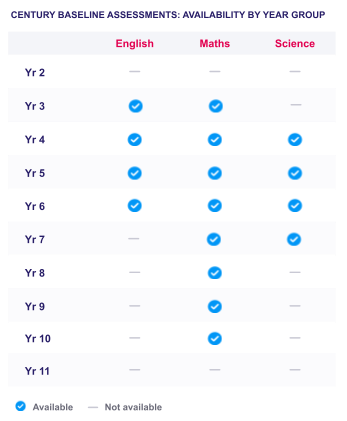
CENTURY currently offers baseline assessments for Years 3–10. In Primary, baseline assessments are available in English and maths for Year 3, and English, maths and science for Years 4–6. In Secondary, maths and science are available for Year 7, with maths available for Years 8–10.
The baseline assessments can each be completed within a single lesson and are auto-marked, making it practical to assess multiple year groups within a short period at the start of the year.
Every baseline returns results at pupil, class and year-group level, with school-level reporting also available for trusts. This gives teachers and leaders the ability to move from the broad picture to the specific data behind it.
At pupil and class level, results can help teachers identify topics and skills that need further work and use that evidence to shape teaching sequences, groupings and interventions from the start of the term.
At year-group and school level, leaders can identify broader attainment patterns and gaps, helping to inform decisions about resourcing, staffing and support. For trust leaders, the same framework can be used to understand attainment patterns across schools.
For Year 5 and Year 6, CENTURY baseline scores are standardised against a national sample and a benchmark is provided. Standardised and benchmarked reporting is being extended across the rest of the Assessment Suite.
CENTURY Student Wellbeing Tool
Alongside the academic baseline assessments sits the CENTURY Student Wellbeing Tool, which measures five areas of wellbeing: School Connectedness, Academic Efficacy, Joy of Learning, Educational Purpose and Safety.
The short survey takes pupils less than five minutes to complete. We recommend running it a few weeks into the term, once pupils have had time to experience their new class, teacher and routines. This gives leaders an early view of which pupils may need additional support with settling in, before difficulties escalate into behaviour, attendance or safeguarding concerns.
The wellbeing data can then be considered alongside the academic picture from the baseline assessments. A pupil who is struggling academically and reporting low academic efficacy may need a different response from one whose attainment is secure but who is struggling with school connectedness, for example.
With academic and wellbeing data available in the same Assessment Suite, leaders do not have to reconcile information from separate systems. Instead, they can bring two important pieces of evidence together to develop a more rounded understanding of how pupils are starting the year.
Starting the year with better evidence
A strong start to the year comes from combining two things: the professional judgement of teachers and leaders, and a clear, current picture of where pupils actually stand.
Baseline assessment provides that second piece of evidence. It gives schools a consistent starting point for understanding attainment, identifying gaps and deciding where action may be needed. Where assessment is also standardised or benchmarked, it can provide an additional reference point for comparing pupils and cohorts against a wider population.
But academic attainment is only one part of the picture. Understanding how pupils are settling into the new year matters too.
CENTURY’s Assessment Suite brings these two perspectives together, with baseline assessments across Years 3 to 10 and a Student Wellbeing Tool for the whole school, with reporting available at pupil, class, year-group and school level.
The result is a clearer, more evidenced starting point for the year ahead: one that helps teachers plan, helps leaders identify where support is needed, and gives schools and trusts a stronger basis for the decisions they make from the first weeks of term.
Ready to build a stronger start to the year?
Book a demo to see CENTURY’s baseline assessments and Student Wellbeing Tool in action.
Already working with CENTURY? Speak to your account manager about getting set up for this term.
CENTURY in the news
View all News
-

News
21st October 2026
International study finds students using CENTURY up to 58% more likely…
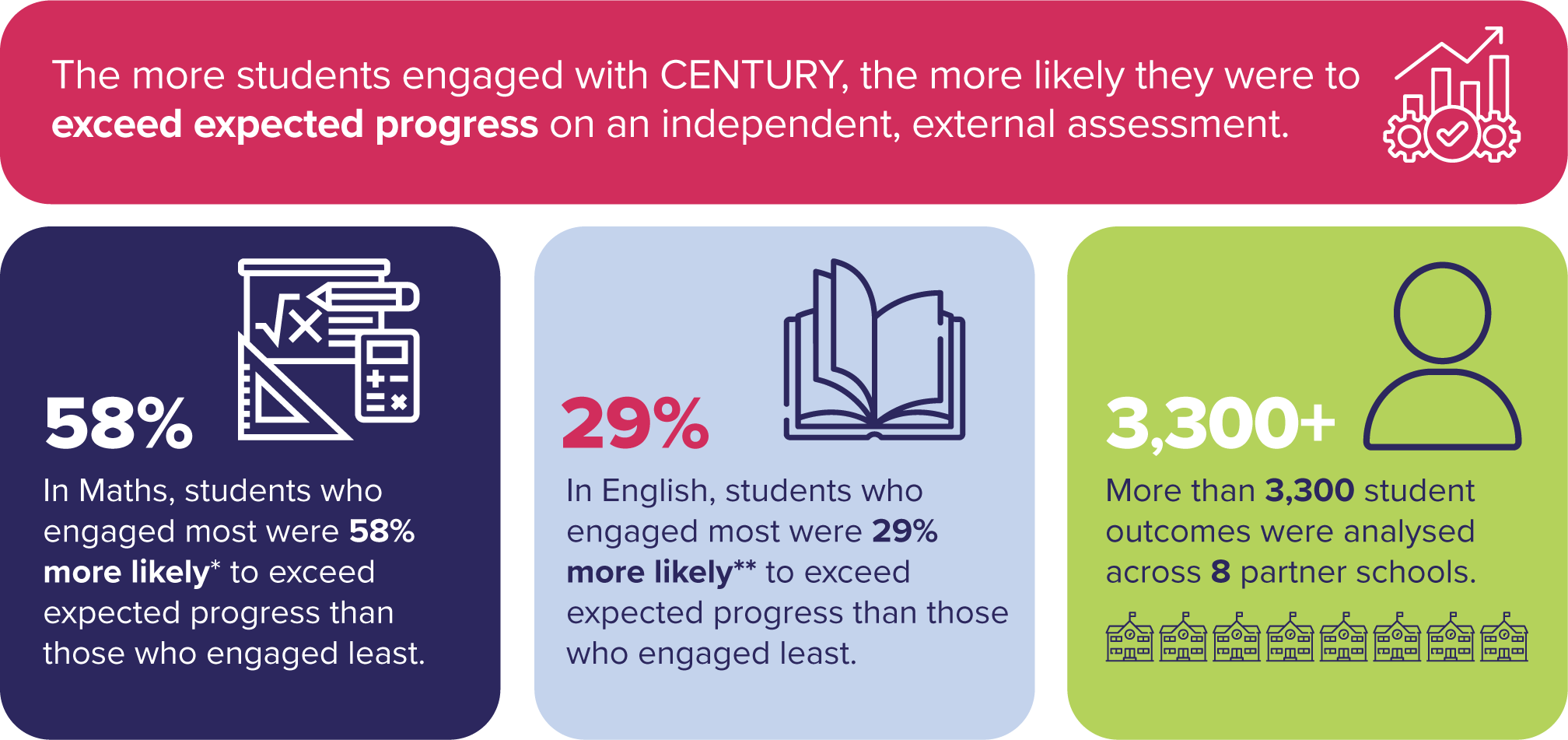
A new study of more than 3,300 progress outcomes across eight Inspired Education Group schools found students who engaged most with CENTURY were up to 58% more likely to exceed expected progress in maths and 29% more likely in English.
Read more
-

Case studies
19th October 2026
How Myanmar Vision International School delivers personalised learning for IGCSE
Myanmar Vision International School in Yangon made CENTURY the main way it teaches IGCSE maths and science. IGCSE Coordinator Andrew Rogers explains how personalised learning, backed by one-to-one support from learning guides, works for a small cohort.
Read more