Teaching good learning habits on CENTURY
Estimated reading time: 2 minutes
CENTURY is an AI-powered online learning platform that personalises learning and provides teachers with actionable insights to support their teaching. Taryn Davison, a former primary teacher now on our Customer Success team, leads training on how best to use the platform. Wanting to see how to better incorporate our data insights, she taught a CENTURY maths lesson weekly for half a term to a Year 4 class at St. John’s C of E Primary School, Abram. Part of Quest Academy Trust, St. John’s has been using CENTURY for the past six years. This blog series shares her findings.
One of the first challenges I noticed in class was that students tended to rush through the CENTURY nuggets without engaging with the learning material. To address this, as a class, we established a set of expectations together to maximise their use of CENTURY:
1. Watching the videos:
- I showed students that I could track whether they watched the instructional videos and began incentivising this behaviour.
- I encouraged them to use headphones and activate subtitles to follow along more effectively.

2. Engaging with the content:
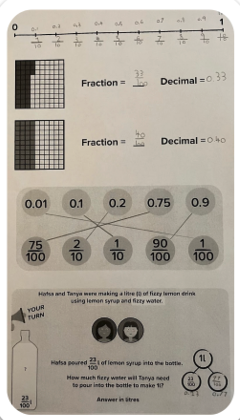
- Students were initially skipping the “Your Turn” opportunities in the videos, so I preemptively captured screenshots of these sections. During the lesson, students were required to pause the video and complete these tasks before moving on. I collected these completed tasks to ensure accountability.
- Once students were used to this expectation, I allowed them to use their whiteboards/jotters instead.
3. Retrying low scores:
- We established a “Go for Green” rule, encouraging students to aim for a 70% score or higher. This reduced the tendency to rush through the work and motivated them to revisit and improve their performance on CENTURY nuggets.

- We established a “Go for Green” rule, encouraging students to aim for a 70% score or higher. This reduced the tendency to rush through the work and motivated them to revisit and improve their performance on CENTURY nuggets.

4. Rewards system:
- We developed these rules together, and I introduced CENTURY prizes for students who re-watched videos and made multiple attempts to improve their scores. Knowing that I could monitor their efforts via the Markbook, along with the added motivation of rewards, such as CENTURY chocolate or a postcard home, significantly increased their engagement.
Key Expectations:
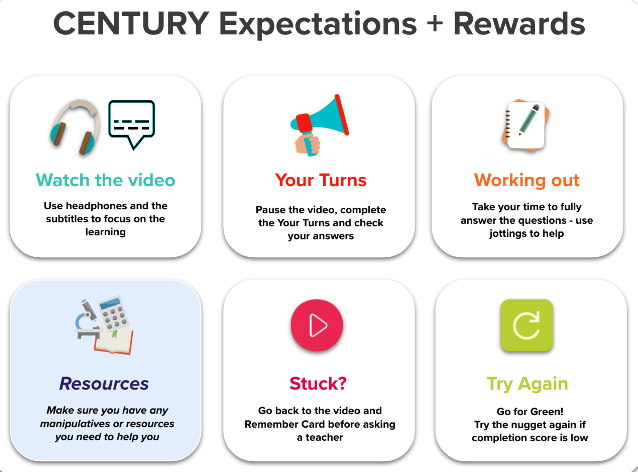
These were the expectations we came up with as a class:
Takeaways:
- Rewards and expectations: Explicitly instruct and model how to complete tasks like “Your Turns.” Students often need guidance and reinforcement to adjust to these expectations, especially when they are used to rushing through tasks. A strong reward system can help encourage the desired behaviour.
- Focus on effort: Reward not just high scores, but also efforts like repeating nuggets, watching videos, and spending time on questions. CENTURY’s tracking tools make it easy to monitor and reward these behaviours.
- Control content access: Students may gravitate toward easier tasks, such as multiplication tables, instead of more challenging material. To ensure they focus on the appropriate year group work, limit their access to certain content unless specific practice is required.
Tune in next week to hear how Taryn used CENTURY as a whole class activity. Click here to book a demo of CENTURY.
CENTURY in the news
View all News
-

Blog
22nd September 2026
Belonging is part of the attainment story
New DfE research finds that pupils who feel they belong at school score, on average, almost a full GCSE grade higher across their results than those who don't. Here's what the findings mean for schools and colleges already tracking wellbeing.
Read more
-

Case studies
16th September 2026
Turning Assessment Data into Curriculum Intelligence at GEMS Winchester School Dubai
When regional disruption threatened Term 3 assessments in spring 2026, GEMS Winchester School Dubai worked with CENTURY to turn assessment data into curriculum intelligence, informing teaching decisions within hours rather than weeks.
Read more