Belonging is part of the attainment story
Estimated reading time: 4 minutes
A pupil who doesn’t feel they belong at school is, on average, doing worse. Not slightly worse, but close to a full GCSE grade worse across their entire set of results. That’s the headline from research commissioned by the Department for Education, and it’s some of the clearest evidence yet that wellbeing and attainment aren’t separate agendas competing for the same time and budget. They’re connected.
The research analysed survey responses from 4,763 pupils in 165 English schools, linking their answers about school belonging to their actual Key Stage 4 attainment data. That makes the findings particularly striking: the research connects what pupils say about their experience of school with their measured academic outcomes.
A GCSE grade’s worth of difference
The research measured pupils’ sense of belonging against their Attainment 8 scores, the metric that averages a pupil’s results across eight GCSE subjects. After accounting for prior attainment, pupil characteristics and bullying, pupils who strongly disagreed that they belonged at school scored 7.72 points lower on average than those who strongly agreed, a gap equivalent to almost a full GCSE grade across all eight subjects. Pupils who simply disagreed, without feeling strongly about it, scored 4.02 points lower. The DfE is careful to note that this shows an association rather than proven cause and effect, but the scale of the gap is hard to ignore.
Which pupils report lower levels of school belonging?
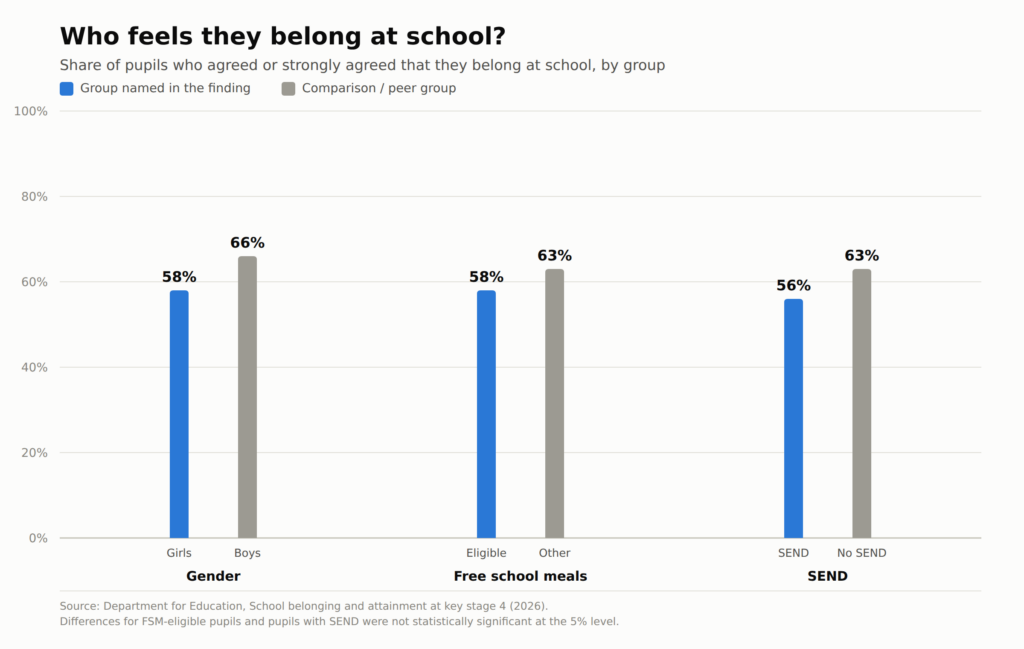
The same research found clear disparities in reported belonging. Girls, pupils eligible for free school meals (FSM) and pupils with SEND were less likely to say they felt they belonged at school than their peers, although the differences for FSM and SEND were not statistically significant at the 5% level.
58% of girls felt they belonged at school, against 66% of boys
58% of pupils eligible for free school meals felt they belonged, against 63% of other pupils
56% of pupils with SEND felt they belonged, against 63% of pupils without
These areexactly the groups schools already spend the most pastoral effort trying to support. In light of these findings, having a reliable way to measure belonging, rather than infer it, more useful than ever.
The government’s approach to measuring school belonging
The findings add weight to a direction of travel already set out in the DfE’s Every Child Achieving and Thriving white paper, which sets out an explicit ambition: every school monitoring pupils’ sense of belonging and engagement by 2029, through a planned pupil engagement framework, up from around 60% of schools doing so today. That ambition isn’t sitting on a shelf: in April, the first major piece of wellbeing-focused legislation – The Children’s Wellbeing and Schools Act 2026 – received royal assent. While the Act doesn’t put wellbeing monitoring on a statutory footing itself (that’s still due through the separate pupil engagement framework), it shows a government moving from writing ambitions down to legislating for them. This legislation follows the same logic already built into Ofsted’s current framework, which grades schools on ‘personal development & wellbeing’ as a standalone judgement area.
Put together, the direction of travel is clear. Wellbeing monitoring is moving from good practice to expectation. School leaders can be getting ahead of expectation and embedding best-practice before it’s required by ensuring they have a reliable way to track wellbeing today.
What it means for FE and training providers
Attainment 8 is a schools-only measure, so this particular study doesn’t speak directly to post-16 outcomes. However, there is a parallel shift in post-16 inspection towards making learner wellbeing, belonging and participation more explicit. Under Ofsted’s renewed framework, ‘participation and development’ is a graded evaluation area, and inspectors consider whether learners belong, feel valued and are supported to thrive.
Separate research from the Association of Colleges found that 88% of responding colleges identified poor mental health as one of the top three reasons for poor student attendance in 2023/24, up from 50% before the pandemic. The 2024/25 survey paints a starker picture still: 90% of colleges reported an increase in 16-18 year-olds disclosing mental health issues, and 74% reported an increase in suicide ideation in the same age group over the previous year. The AoC have laid out a Mental Health Charter, which sets out standards colleges can work towards.
These data points confirm that the underlying question – “do you actually know how your learners are doing, beyond attendance and grades?” – is the key question to be asking.
You already have a way to measure this
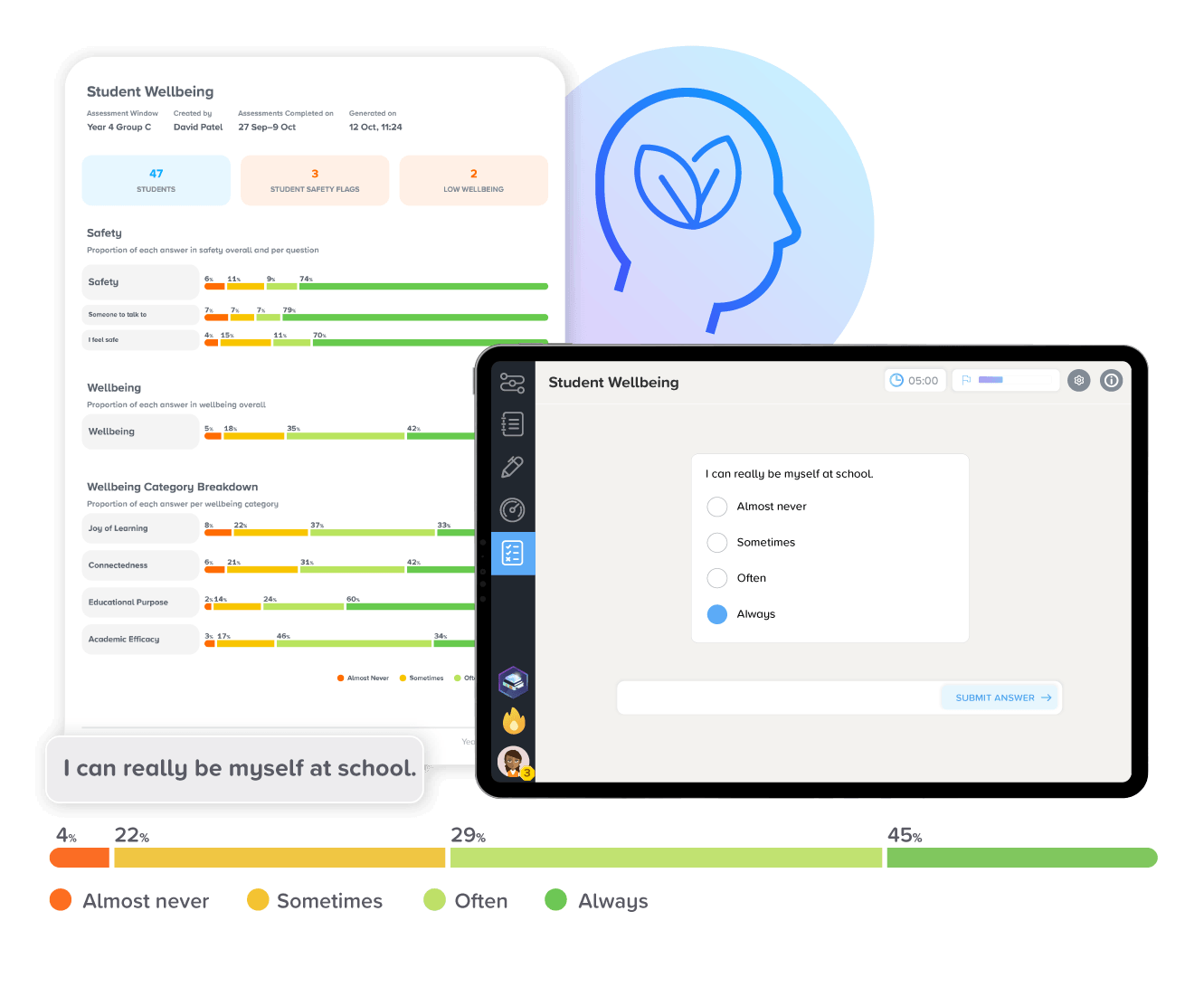
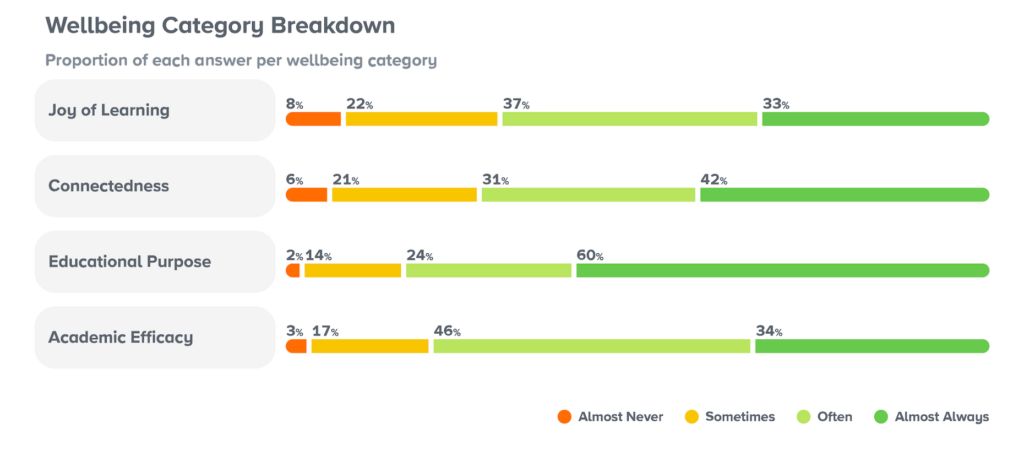
This is precisely the question the CENTURY Wellbeing Tool was built to answer, and it’s included in every CENTURY subscription at no extra cost. Built on the validated Student Subjective Wellbeing Questionnaire, it takes a learner under five minutes to complete and reports back across five domains: connectedness, academic efficacy, joy of learning, educational purpose and safety. Reporting is immediate and confidential, with safety flags for anyone who may need immediate support.
You can run the questionnaire as often as you like: our recommendation is to do a termly check in with the tool to get a picture of belonging alongside the academic data you already track on CENTURY. We covered how the tool works in more detail in our article Supporting Every Learner.
Government policy is heading towards a world where every school and college can answer, with evidence, whether their pupils and learners feel they belong. What a school or college does with a term’s worth of data is the part that actually moves things, and it’s a question worth returning to on its own. For now, though, the practical starting point is making sure you’re capturing that data at all. CENTURY customers already have the tool to do this, and if you haven’t run this term’s survey yet, now’s a good time to start.
If you’re not yet a CENTURY customer, book a demo to see the Wellbeing Tool for schools or post-16 learners for yourself.
Karly Sanderson is CENTURY’s Curriculum and Assessment Developer for Science and Wellbeing.
CENTURY in the news
View all News
-

Case studies
16th September 2026
Turning Assessment Data into Curriculum Intelligence at GEMS Winchester School Dubai
When regional disruption threatened Term 3 assessments in spring 2026, GEMS Winchester School Dubai worked with CENTURY to turn assessment data into curriculum intelligence, informing teaching decisions within hours rather than weeks.
Read more
-

News
14th September 2026
CENTURY Launches Global Wellbeing Research Initiative with COBIS
CENTURY has partnered with COBIS to launch the Global Wellbeing Research Initiative, giving every member school access to the Wellbeing Tool and a place in the first sector-wide wellbeing benchmark for British international schools. The Autumn survey window opens on…
Read more