Closing the revision gap: an evidence-based guide to GCSE revision
Estimated reading time: 9 minutes
Take any normal evening in May and you will find a Year 11 student preparing for her GCSE exams. She has her text book open. She has a rainbow of highlighters at her fingertips. She has been at it for two hours, and the pages are getting steadily more multicoloured. She feels like she is working hard. She is working hard. But come exam day, the information may not come back to her in the way the highlighted pages now do.

This is the revision gap: the distance between the strategies students use because they feel productive, and the strategies cognitive scientists have shown actually work. Research surveying nearly 40,000 UK students found that 37% of revision time – over a third – still goes on re-reading, highlighting, and making notes, methods consistently rated as among the least effective by decades of learning research.
It is a striking figure, but the more revealing one sits beneath it: higher-performing students use evidence-based methods significantly more often. The gap between how students revise and what evidence supports is more than academic curiosity; it correlates visibly with results.
This article looks at what the research tells us about evidence-based GCSE revision, why so many students still revise the wrong way, what schools can do to help close the revision gap, and what happens to results when they do.
What the evidence says about effective GCSE revision
For all the changes to curricula, exam specs and classroom technology over the past decade, the science of how students learn has been remarkably stable. The techniques which are most effective are those that force the brain to do the cognitive work of retrieving, connecting and discriminating between ideas, rather than passively re-encountering them.
In a landmark 2013 review, John Dunlosky and colleagues evaluated ten common study techniques against the available evidence. The decade since has tested those findings in real classrooms at scale:
- A 2021 meta-analysis by Yang and colleagues, focused specifically on classroom rather than laboratory studies, found a medium positive effect for testing in classroom settings (g ≈ 0.50).
- A 2021 systematic review by Agarwal and colleagues confirmed that retrieval practice benefits learners across age groups and ability levels, including those with SEN.
- A 2021 meta-analysis by Latimier, Peyre and Ramus examined the benefit of spacing out retrieval practice across more than 40 studies, finding a consistent and substantial advantage for spaced over massed practice.
- A 2015 classroom study by Rohrer and colleagues found that Year 7 students using interleaved maths practice scored almost twice as well on a delayed test than those using conventional blocked practice.
The Education Endowment Foundation’s 2025 Metacognition and Self-Regulated Learning guidance classifies the overall approach of supporting students to develop and maintain effective learning strategies as “high impact, low cost”, with an average effect equivalent to eight additional months of progress per year.
Three techniques are consistently rated as the most effective:
Retrieval practice, also known as the testing effect. Repeatedly recalling information from memory strengthens long-term retention more effectively than re-reading it. The harder the retrieval – free recall over multiple choice, for instance – the stronger the effect. Importantly, retrieval practice is also diagnostic: failing to recall something accurately tells a student exactly what they need to focus on.
Spaced practice. Reviewing content at increasing intervals over days and weeks consistently outperforms cramming the same total amount of study into a single session.
Interleaving. Mixing different problem types or topics within a single study session rather than focusing on one type before moving to the next improves long-term performance, particularly in problem-solving subjects like maths. In one study, students using interleaved practice performed three times better on a delayed test than those using ‘blocked’ practice, despite performing worse during the practice itself.
These techniques all feel harder in the moment than the alternatives. In fact, this is exactly what makes them effective: the struggle of retrieving the correct answer – whether that’s in a test, when switching through topics during a session, or after a gap since material was last reviewed – is what creates the stronger memory.
Why students still revise the wrong way
If the evidence is so clear, why do so many students still spend their evenings highlighting?
Part of the answer is that the less effective techniques feel like they are working. Re-reading a chapter creates a sense of growing familiarity with the material, and that familiarity feels a lot like learning. Cognitive scientists call this the illusion of fluency: students mistake the ease of recognising material for the ability to recall it. On exam day, the gap between the two becomes painfully clear.
The Revision Census, the largest UK study of student revision habits to date, suggests the problem runs deeper than poor strategy choice. Even when students adopt techniques that should work, they often execute them passively. Nearly 4 in 10 students who use flashcards spend the majority of their flashcard time making or re-reading the cards, rather than testing themselves with them. The technique is right; the execution turns it back into re-reading.
Spacing fares no better. 76% of students in Years 10 to 13 do not space their revision consistently. Some know they should and struggle to plan it; others have not been convinced it matters.
The pattern is consistent: the methods students gravitate towards feel productive and are not, while the methods that work feel hard and are avoided. Closing the revision gap is not a question of willpower or effort. Students are working hard. So how can we ensure the hard work they are doing is the kind that actually builds durable knowledge?
Why schools struggle to close the revision gap
Most teachers are well aware of the evidence. Retrieval practice, spaced practice and interleaving have all been embedded into UK educational guidance for years, and the EEF’s most recent recommendations make their importance unambiguous. A 2024 study by Bates and colleagues, looking at how UK teachers actually use retrieval practice in the classroom, confirmed that the techniques are widely understood but classroom implementation remains uneven, and varies significantly in quality.
The challenge schools face is delivery at scale.
Embedding evidence-based revision into a Year 11 cohort is fundamentally a problem of scale. Hundreds of students, working largely outside school hours, have to choose the harder strategy over the easier one. Not just once, but repeatedly, consistently, and over months leading up to exams. Even the best-designed teacher intervention cannot follow each student home each evening, and as Dunlosky himself noted in his original review, the strategies only work if students use them correctly.
This is the real revision gap: the gap between what teachers know and what they can realistically expect every student, every week, in every subject to actually do.
How CENTURY is built on the evidence
CENTURY is a practical implementation of the evidence base. The techniques the research endorses are built into how the platform works by default.
Retrieval practice is structural, not optional. Every nugget – our name for a micro-lesson – ends with assessment questions that require students to retrieve what they have just studied. There are no opportunities for students to passively learn a topic: the act of retrieval is built into every nugget as standard.
Spaced practice is automated. CENTURY’s Memory Boost function tracks what each student has learned and when, and reintroduces previously studied content at increasing intervals. This directly addresses the finding that the majority of GCSE-age students do not space their revision consistently. Memory Boost does this planning for them.
Interleaving is built into the Recommended Pathway, which mixes topics based on each student’s individual strengths and gaps rather than presenting them in textbook order. Students are continually required to identify the type of problem in front of them, not just apply the method they have just been shown.
Feedback is immediate and specific. Questions are automatically marked, and students receive tailored explanations rather than just a right/wrong verdict. This matters because feedback is one of the strongest moderators of retrieval practice’s effectiveness. Without it, students risk reinforcing misconceptions.
Teachers see the data. Class- and student-level dashboards highlight where understanding is strong, where it is fragile, and which individuals need targeted support. The platform does not replace the teacher’s judgement, it gives them somewhere to point it.
What the data shows: GCSE outcomes at Brighton Hill
Designing a platform around the evidence is one thing. Showing it makes a difference to GCSE results is another.
A 2025 impact analysis of GCSE results at Brighton Hill Community School, a non-selective secondary in Hampshire that has used CENTURY across core subjects for over five years, suggests that it does.
Among students whose CENTURY use averaged at least 20 minutes a week, 9 in 10 achieved a grade 4 or above in both English and maths, and 8 in 10 achieved a grade 5 or above in both subjects. The national averages for the same benchmarks are 65.1% and 45.9% respectively.
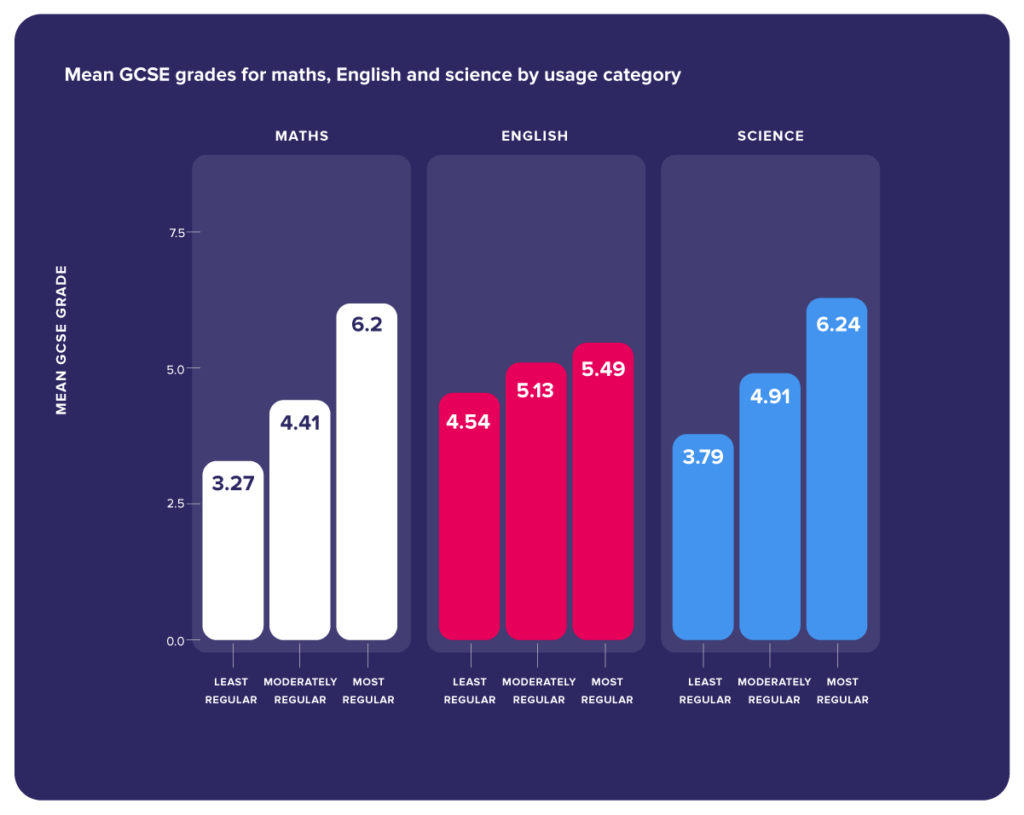
The most regular users of the platform achieved Attainment 8 scores 25 points higher on average than the least regular users, and over 14 points above the national average. Across English, maths and science, regular users were achieving on average between one and three GCSE grades higher than infrequent users.
Two findings stand out for school leaders.
The first is on equity. Pupil Premium students who used CENTURY for at least 25 minutes a week matched the GCSE performance of non-Pupil Premium students across the school. This is a meaningful result in a context where the disadvantage gap remains one of the most stubborn challenges in English education.
The second is on prior attainment. Low prior attainers whose CENTURY use averaged at least 20 minutes a week made, on average, half a grade more progress in English and maths than would have been predicted from their KS2 scores. The benefit was not confined to already-able students; it extended across the prior attainment range.
A note on what these figures show. The Brighton Hill data is correlational rather than experimental: it demonstrates that students who used CENTURY regularly achieved better outcomes than those who did not, in a real school over five years. The mechanism behind that correlation — retrieval practice, spacing, interleaving, immediate feedback — is what the research base set out earlier in this article causally supports.
David Watkins, Deputy Head Teacher at Brighton Hill, puts it in plainer terms: “We’ve relied on CENTURY for over five years now, and we’ve genuinely seen the difference it makes to our students’ GCSE results. It’s become a core part of how we approach teaching and learning.”
How schools and teachers can put this into practice
We don’t lack the evidence to close the revision gap. Rather, the challenge is making what we already know about effective revision consistently available to students who, left to their own devices, will reach for the highlighters.
Here are three evidence-based approaches that work in any classroom:
- Teach students about the science of learning. The EEF’s 2025 metacognition guidance shows that students benefit from being taught how to plan, monitor and evaluate their own learning. Ensure you have time to explain retrieval practice and spacing and why they feel harder to give students a reason to choose them.
- Build low-stakes retrieval into every lesson. Starter quizzes, mid-lesson recall tasks and end-of-week reviews are simple to implement and require no specialist tools. They model for students what effective revision looks like, but you can take this one step further by explaining why the quizzing technique is working for them.
- Plan revision across weeks, not sessions. Spaced practice cannot be retrofitted in the fortnight before exams. Schemes of work that build in deliberate review of earlier topics and/or homework patterns that revisit prior content rather than only consolidating the current unit make spacing a feature of your curriculum.
These principles work in any classroom. To apply them at scale, across a full cohort, over the months of term time when GCSE revision actually happens can be more challenging.
EdTech platforms can help with this, but must be built on the findings of cognitive science research to ensure the evidence-based version of revision is what students experience by default.
The Year 11 student with her highlighters is working hard. The question every school must ask is whether the work she is doing is the kind that lasts.
Want to know more?
You can download the full Brighton Hill GCSE impact analysis, with detailed figures, methodology and case study notes for school leaders.
For more information about the research underpinning CENTURY, read our article The Science behind CENTURY.
If you would like to see how CENTURY supports GCSE revision in practice, you can book a demo with our team. We will walk you through the platform with your school’s context in mind.
CENTURY in the news
View all News
-

News
21st October 2026
International study finds students using CENTURY up to 58% more likely…
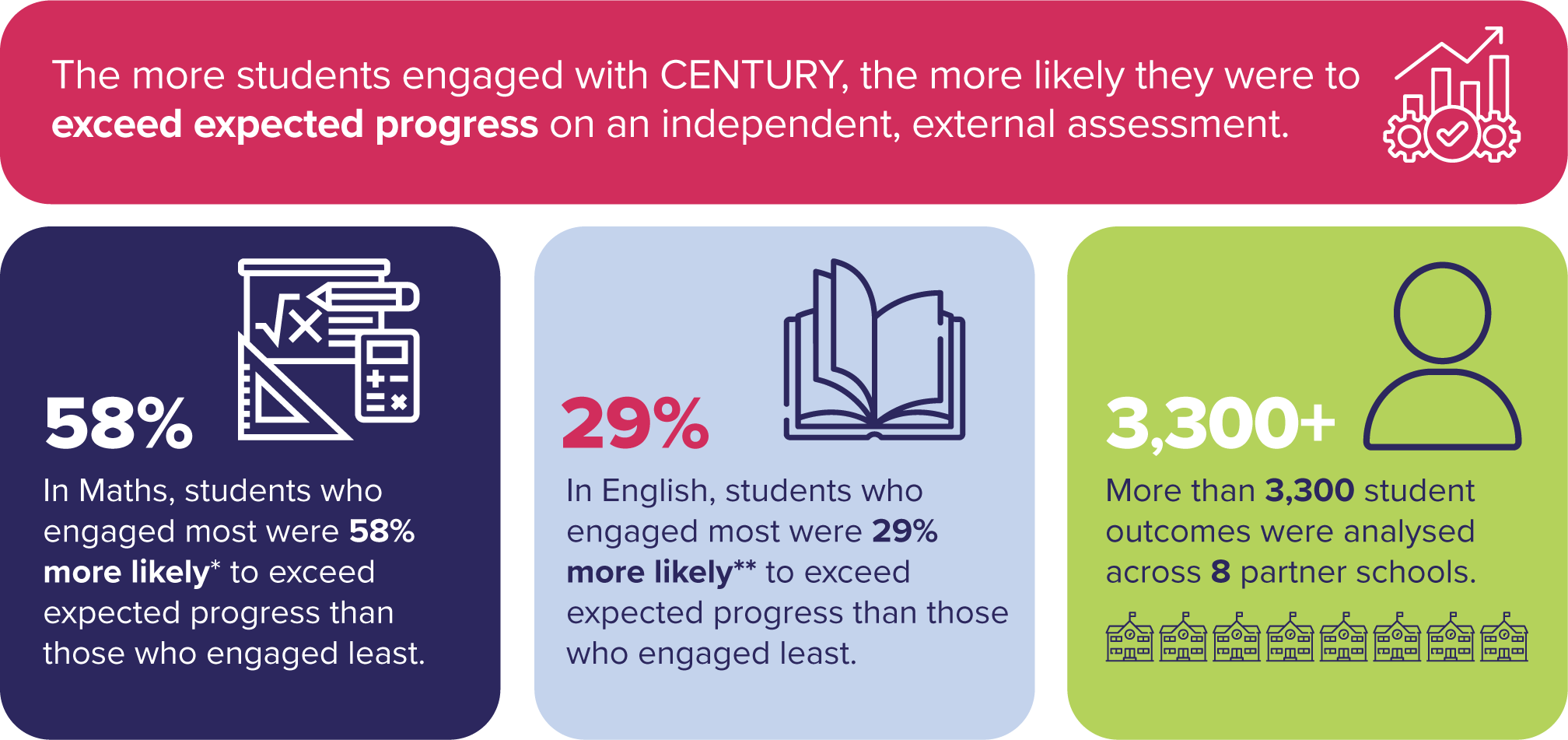
A new study of more than 3,300 progress outcomes across eight Inspired Education Group schools found students who engaged most with CENTURY were up to 58% more likely to exceed expected progress in maths and 29% more likely in English.
Read more
-

Case studies
19th October 2026
How Myanmar Vision International School delivers personalised learning for IGCSE
Myanmar Vision International School in Yangon made CENTURY the main way it teaches IGCSE maths and science. IGCSE Coordinator Andrew Rogers explains how personalised learning, backed by one-to-one support from learning guides, works for a small cohort.
Read more