The Critical Edge: Why Precision of Language Secures Your Exam Success
Estimated reading time: 5 minutes

As an experienced examiner and teacher, I’ve seen firsthand how vital clear, specific scientific words and technical terms are for getting high marks. I’ve also witnessed countless instances where candidates lost marks despite clearly understanding the concepts, simply because their language wasn’t precise enough; a point stressed by exam boards worldwide.
It might seem challenging to help students improve their grades, but the difference between grade boundaries is often smaller than perceived. In 2025, for the Combined Science foundation paper, only 20 marks separated a 4-4 from a 5-4, and another 20 marks moved a student from 5-4 to 5-5. For the Higher tier paper, a 22-mark increment was needed to go from a 5-5 to a 6-5, and the same jump was required from 6-5 to 6-6. Distributed across six papers, this averages at about 7 marks per paper, meaning just one extra mark per question in a seven-question paper. Similar grade differences apply to triple science, with these gaps becoming even narrower as students aim for grades 7–9.
Whether you’re aiming for grades 4–5 or tackling harder questions for grades 8–9, using vague words, unclear descriptions, or the wrong scientific terms can seriously limit your marks. This article will look at common language mistakes in biology, chemistry, and physics, and offer tips to achieve the clarity needed for top performance.
1. Command Words and Context
A fundamental barrier to scoring highly is failing to acknowledge the command word in the question. For example, it is frequently mentioned in the examiner reports that a mere description, no matter how accurate, is insufficient when the command is ‘explain,’ and conversely, explanations are unnecessary when the command is ‘describe’.
Common errors and remedies:
Failure to explain: For instance, in the AQA Biology HT paper on June 2024, question 2.3
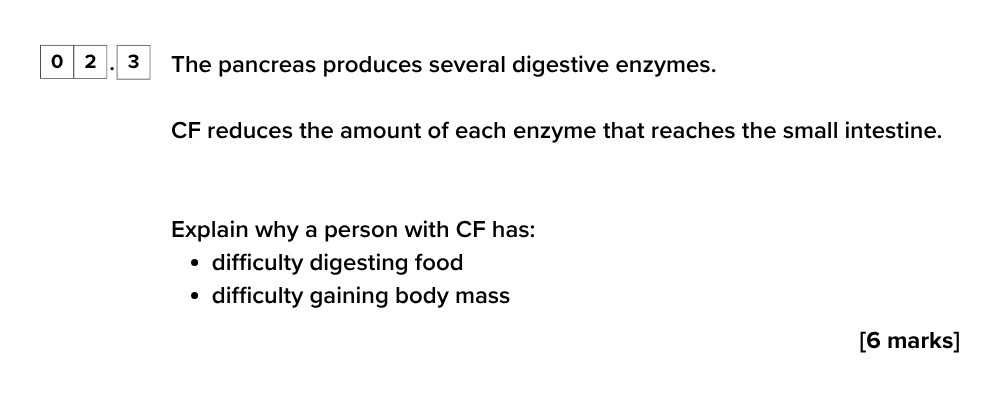
This required a levelled response discussing enzymes, students often described what normally happens in the body without indicating how the problem scenario (e.g., cystic fibrosis context) impacts or reduces these processes, failing to meet the ‘explain’ command.
Strategy: Try the ‘I, we, you’ teaching approach.
- Show a model answer to the students on the board (these can be located from the examination board’s website). Emphasise how the answer makes a scientific point and then adds a reason to explain why that is the correct answer. (I)
- Next, show a partially completed answer, or one that has not scored full marks, then through discussion, ask students to make suggestions to improve the answer. After an initial discussion, ask the students to write down some improvements in their books and then collaborate to create a final model answer that can be compared to the mark scheme. (we)
- Finally, present a new question for students to answer by themselves.
Once completed, students can then discuss with their peers to evaluate if the answer that is written is meeting the demand of the command word, which they can improve before comparing it to the mark scheme. (you)
This strategy can be applied to a range of exam questions, focussing on the different types of command words. To help the students, exam board resources could be made into a handout to help students cross check their answers.
Details of the AQA command words booklet can be found here.
Ambiguous Language: Students often use vague pronouns like ‘it’ or ‘they’ without making it explicitly clear what they are referring to, leading to a loss of marks. During feedback, this can also lead to the response from a student saying, ‘well you knew what I meant’.
Strategy: When discussing concepts in the classroom and when students complete past paper questions, always challenge students to clearly state the subject that they are referring to (e.g., ‘the hormones,’ ‘the bacteria,’ ‘the scientists’). Students should also be aware that answers requiring the examiner to infer meaning will always be marked as incorrect.
Examples from each paper can be found at the end of the document.
Repeating the Question: A common error, particularly in extended writing, is simply paraphrasing or repeating information provided in the question stem instead of adding value or linking it to known scientific concepts.
Strategy: Show different grades of level of response answers and ask students to add specific scientific details to ‘level up’ or ‘upgrade’ their attempts. Ask students to focus on how to link the given information to the science needed to answer the question. Examination boards have many ready-made examples to help students improve their level of response answer skills.
2. Precision of Language
It is crucial for students to adopt a scientific writing style. Failure to utilise precise terminology may result in a loss of marks, even if complex concepts are explained accurately, due to imprecise language.
Using the examiners reports, we can explore common issues where incorrect use of scientific language for Biology, Chemistry and Physics has cost students marks.
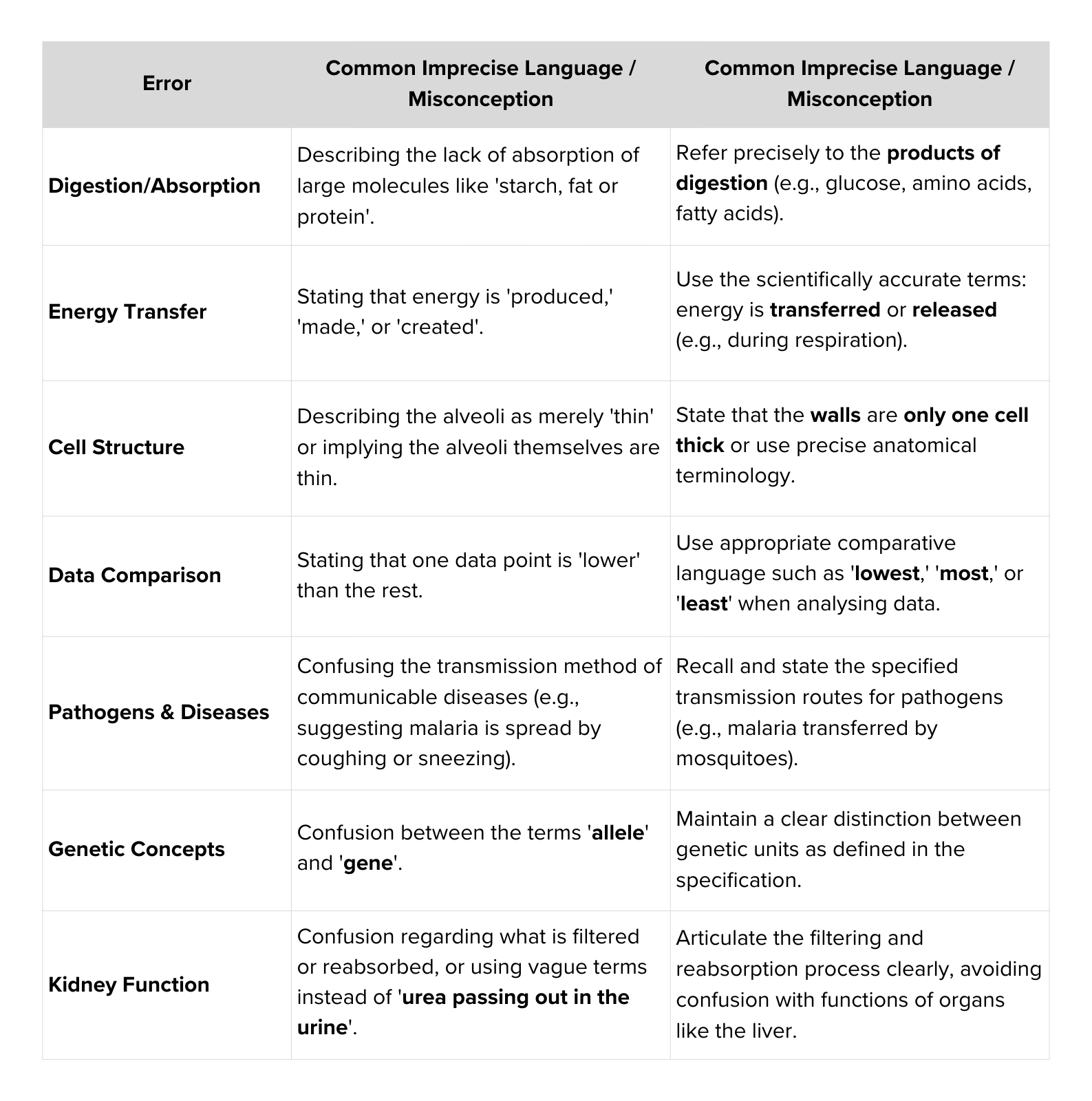
Biological Precision: Terminology and Comparison
Biology demands accuracy when referring to processes, structures, and data comparison.
Common Errors in Biology:
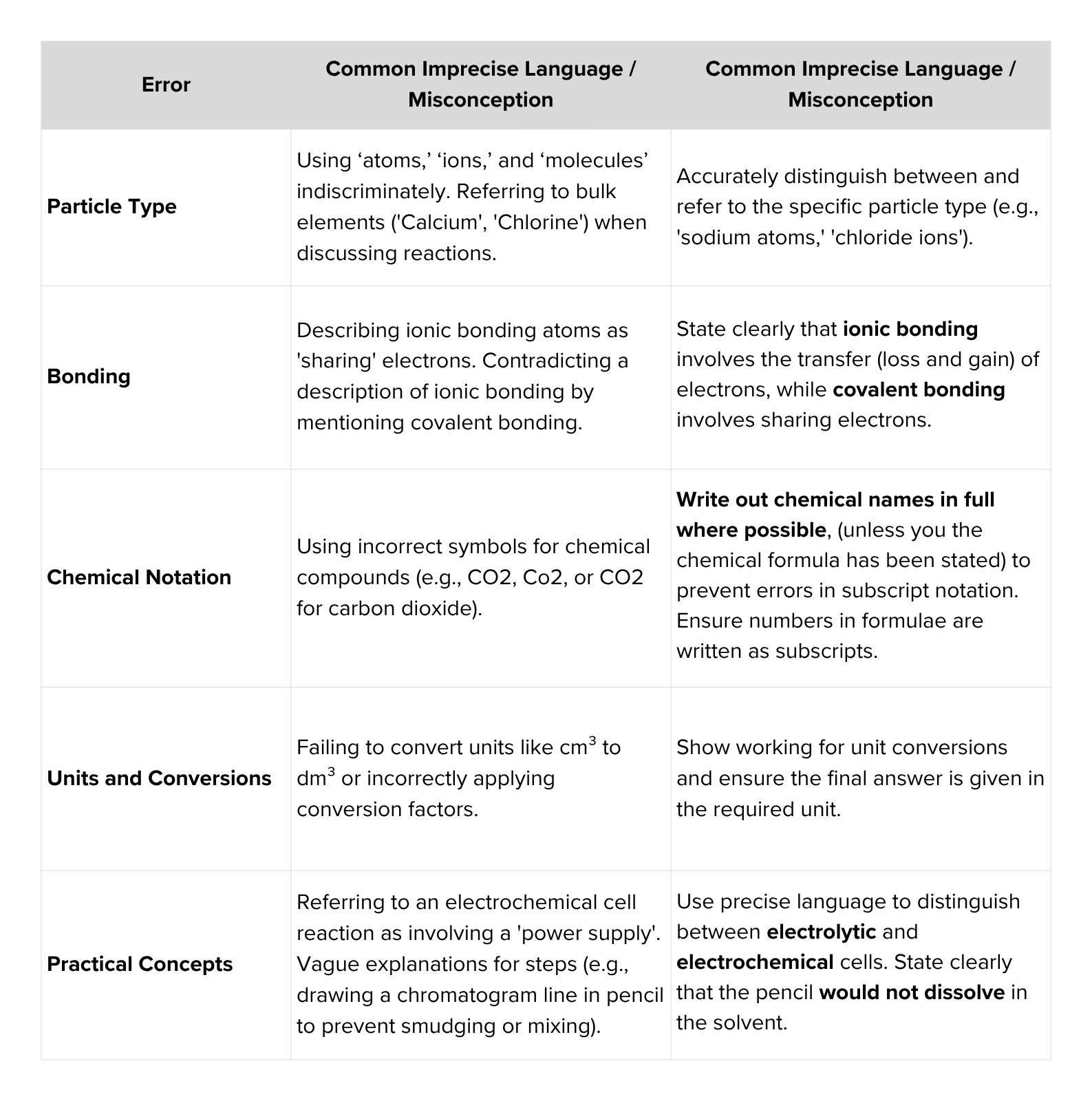
Chemical Specificity: Particles, Bonding, and Notation
Chemistry requires strict adherence to precise technical terminology when discussing the microscopic world of particles and reactions.
Common Errors & Remedies in Chemistry:
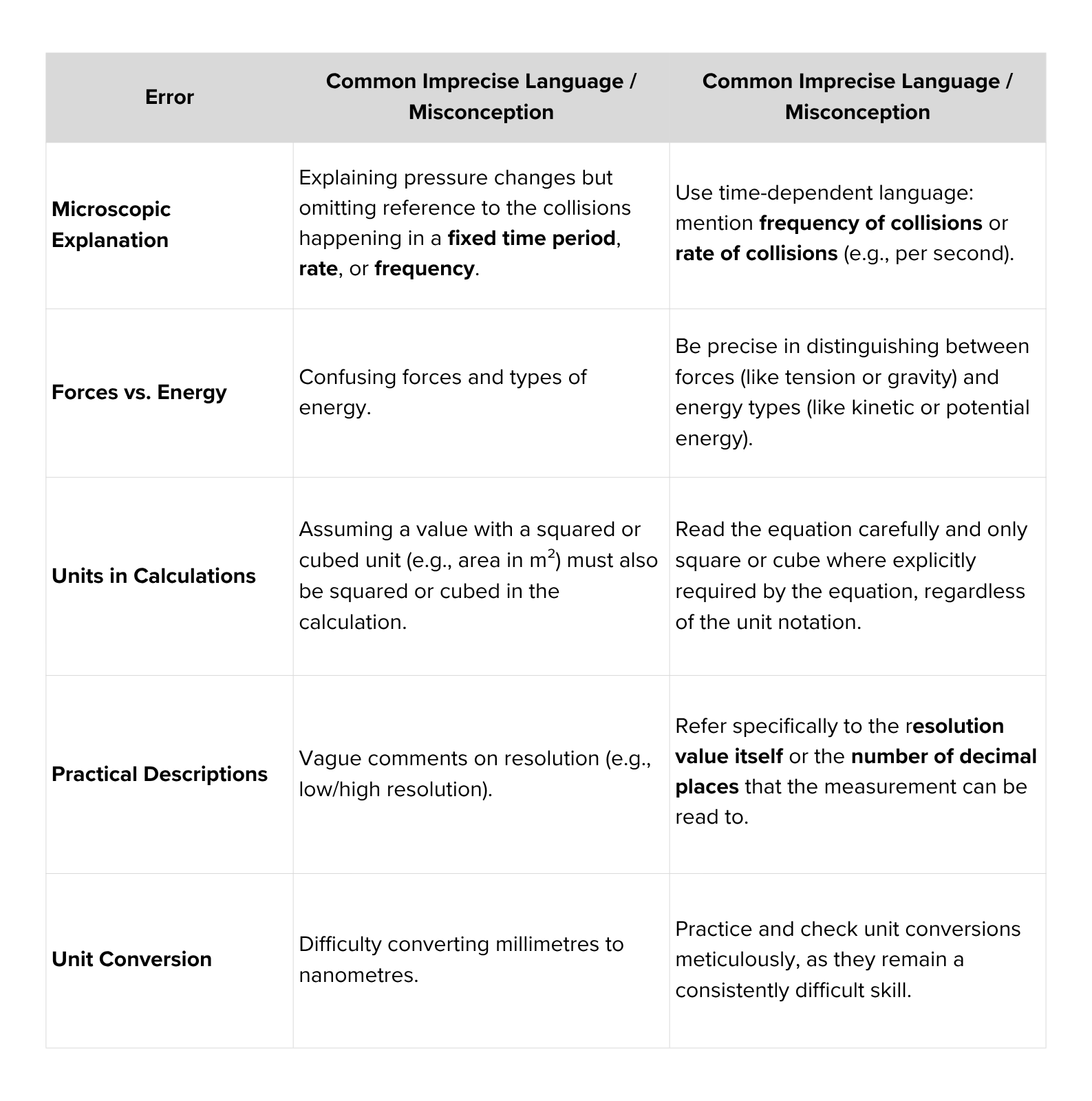
Physics Clarity: Forces, Rates, and Calculations
In Physics, vagueness regarding rates, forces, and units is a common cause of lost marks.
Common Errors & Remedies in Physics:
3. Taking Action
For skilled science teachers and examiners, this is nothing new and is a problem that students experience across the world. So, what can we do about it?
At every opportunity, encourage students to discuss topics like a scientist, challenging them when they use vague terms such as ‘it, they, them’, whilst also emphasising the idea that any answer written that makes the marker assume they ‘know what I mean’, is always going to be wrong.

Foster a culture of always trying to improve exam answers by focussing on these three things:
- Have you done what the command word has asked?
- Did you use specific language, emphasising scientific terms?
- Looking back at your answer, can it be upgraded?
Whilst encouraging students to challenge each other to help embed a culture of continuous improvement.
Finally, use CENTURY to give students the opportunity to practice their examination skills. All of our nuggets assess knowledge by steadily increasing the level of demand throughout the nugget. Giving students the opportunity to practice in a low stakes environment.
Upcoming articles will delve into:
- Utilising CENTURY for exam preparation
- Leveraging CENTURY as a revision tool
- Strategies to support students aiming for grades 7-9
Following this, a series of articles will explore assessments, the construction of diagnostic multiple-choice questions, and metacognition.
Appendix: Specific Examples
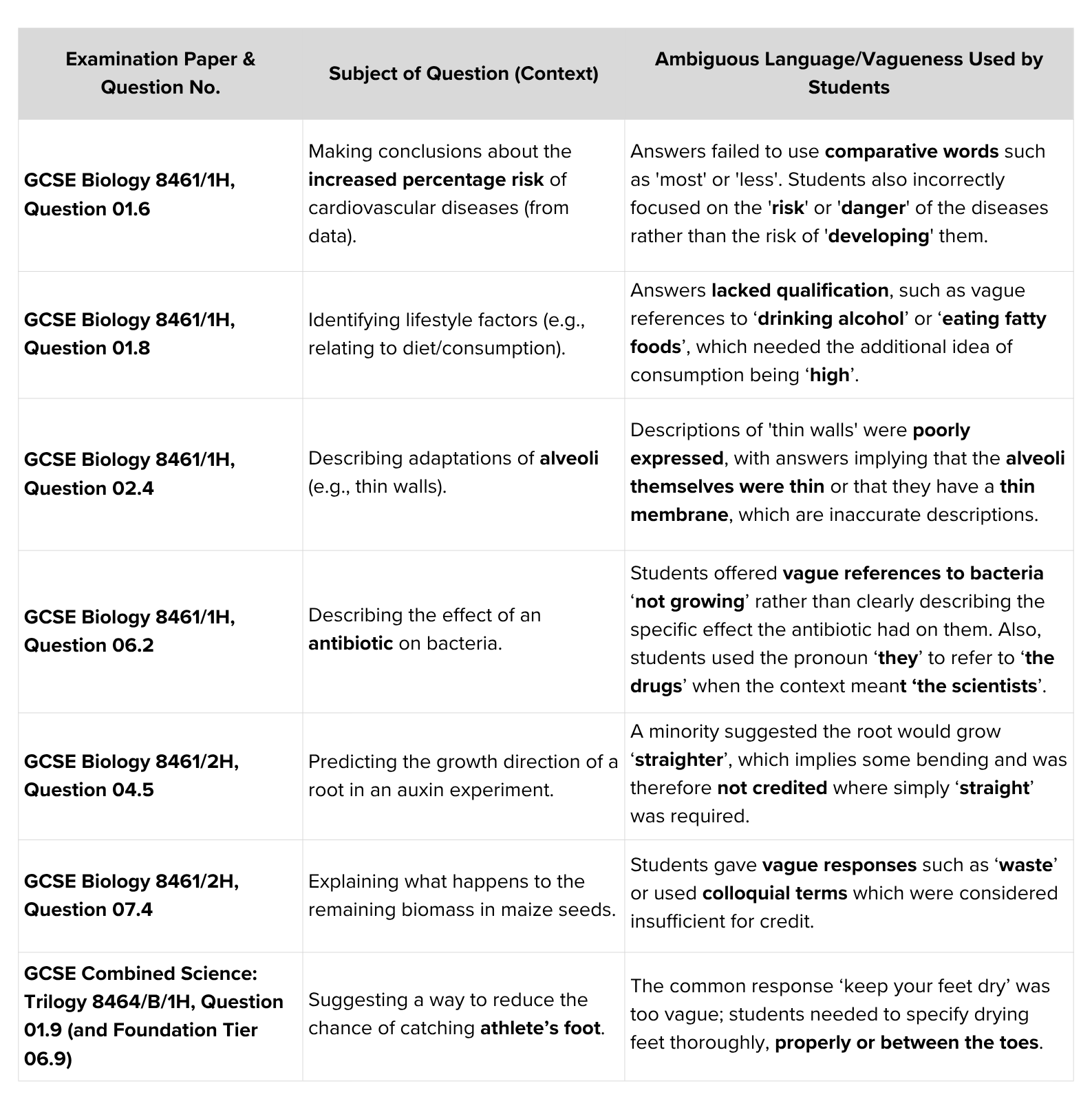
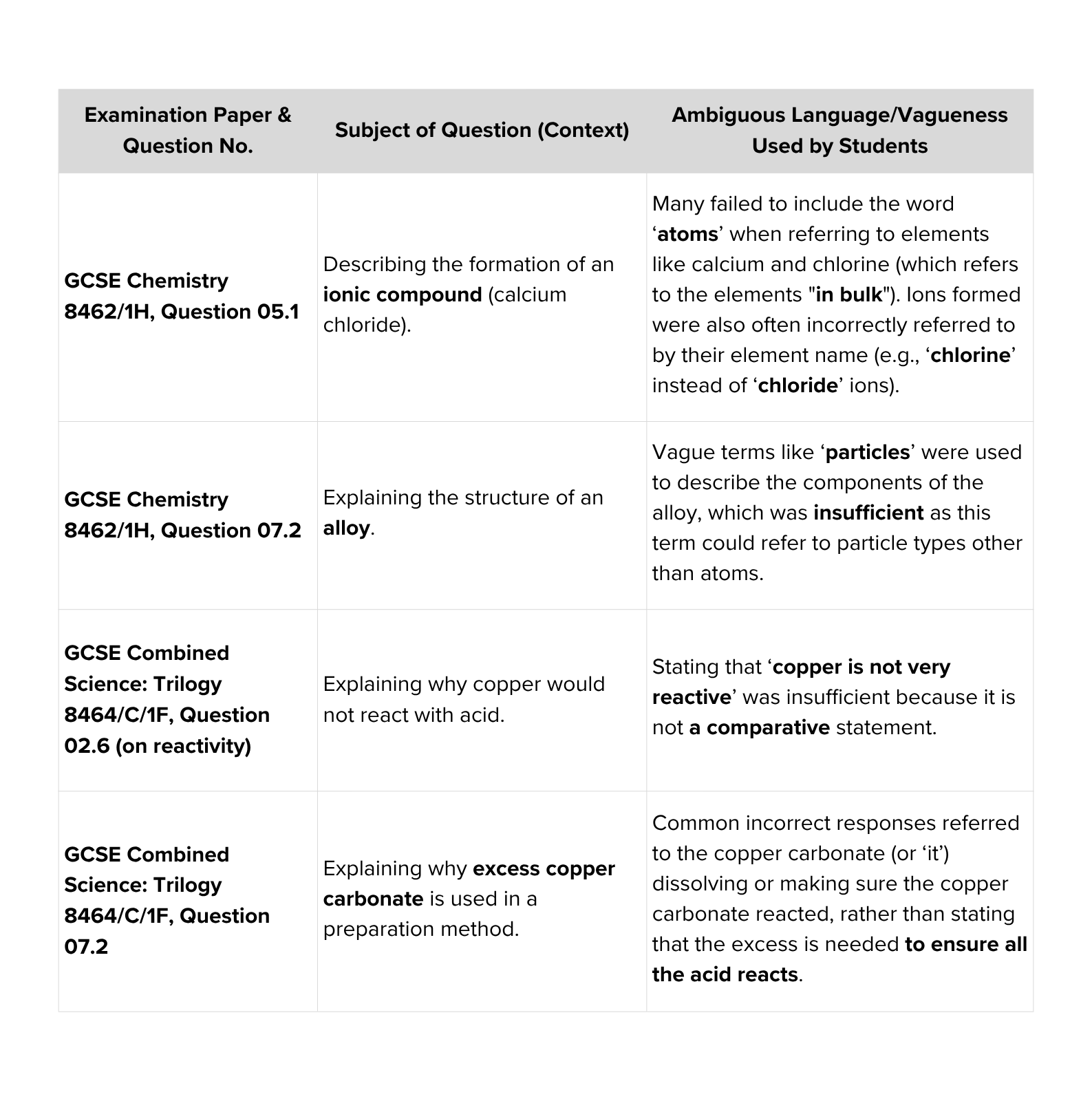
The examination reports detail numerous instances where specific questions were poorly answered due to the use of ambiguous, vague, or imprecise language by students. The reports describe the context of the question and the nature of the linguistic ambiguity encountered by examiners.
Here are examples of specific questions (or question parts) from the exam papers and the corresponding ambiguous language observed:
Biology & Combined Science Examples:
Chemistry & Combined Science Examples:
Physics & Combined Science Examples:
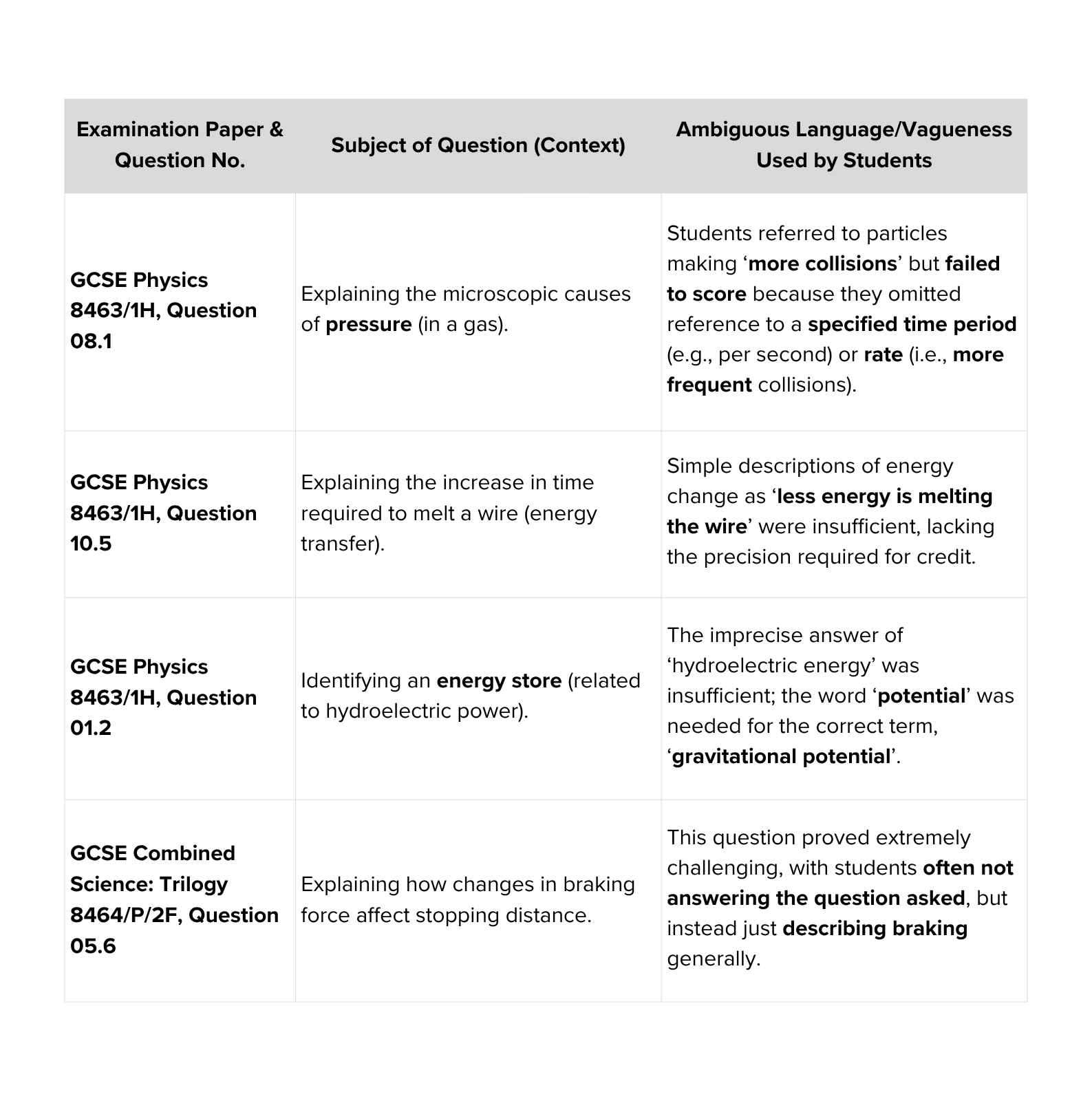
In essence, these reports confirm that questions requiring specific scientific mechanisms, comparative evaluation, or qualification of generalised terms frequently expose the difficulties students have in moving beyond vague or colloquial language to achieve the required level of scientific rigour.
Discover how CENTURY’s Academic Assessments can strengthen students’ academic performance, by heading to our Academic Assessments page.
Learn more about CENTURY’s science resources or book a demo with a member of the team today.
CENTURY in the news
View all News
-

News
19th March 2026
Macmillan Education and CENTURY Announce Strategic Partnership to Transform Phonics Learning
Macmillan Education and CENTURY have announced a landmark partnership, combining their expertise to support learners and teachers worldwide. By harnessing Macmillan Education’s heritage in high-quality resource design and CENTURY’s expertise in building innovative technology, the two organisations are uniquely placed…
Read more
-

Blog
16th March 2026
CTRL’ing AI: Under the hood and beyond the hype
While ChatGPT has been grabbing the headlines, a different kind of AI has been quietly transforming student outcomes for a decade. Let's take a look at the difference between Generative AI and Non-Generative AI to understand how we can really…
Read more