Why organisations love CENTURY’s Smart IA
Estimated reading time: 3 minutes
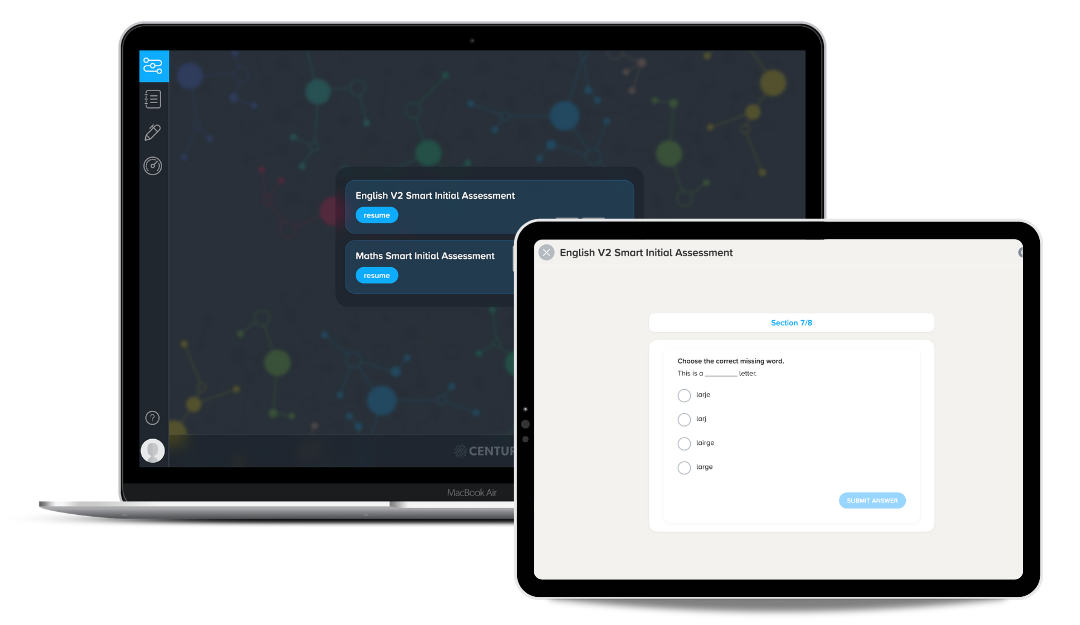
Hundreds of organisations such as FE colleges, ITPs and local councils, have already benefitted from CENTURY’s adaptive initial assessments. Our Smart IA tool is designed to maximise the accuracy of results with minimal testing time. It allows staff to seamlessly administer assessments for English and maths functional skills from Entry 1 to Level 2, with downloadable results only viewed by the tutor. We are also the only providers of a written English initial assessment, saving tutors valuable time on administration and marking.
Here are some of the reasons our partners love CENTURY’s Smart IA:
Quickly establish learners’ ability level
“The Smart IA results are very accurate to their actual ability, which is incredibly important for us. With previous platforms, the instructions weren’t clear and so learners may have completed the whole assessment with a calculator, resulting in an inaccurate level.”
“It’s giving us a lot of confidence in the Smart IA results, whereas before we might find it didn’t match up with their prior learning history. Now we’re getting much more accurate at identifying their levels and giving timeframes on their future achievements.”
Madeleine Robinson, Head of Operations and Transformation at Pareto
“We start off with the CENTURY Smart initial assessments to get the right learner on the right course and CENTURY plays a huge role in this.”
Emma Isles, Functional Skills Manager for Apprenticeships at The Bedford College Group
Efficiency in administering assessments
“Smart IA has improved the efficiency of administering initial assessments. The speedy onboarding process allows learners to start studying on an appropriate course straightaway. The IA is easy to use, and very user friendly. The results are easy to view and the ability to organise results into cohorts helps massively.
Harvey Sparks, IT Security Officer at TrainPlus
Increasing learner confidence
“Using CENTURY’s Smart IA has sped up the process of learners’ initial assessment. By getting an instant functional skill level, we can sit down with the learner and talk them through where they are at in relation to these. It has led to increased learner confidence and satisfaction. Having the Smart IA scores means we are better prepared to track progress and provide the learner with quick feedback on their learning level and progress.”
Dean Flood, Senior Tutor at Pembrokeshire Action for the Homeless (PATH)
All learners have been able to log on and complete their IA independently, which shows it’s a user friendly system.”
Harvey Sparks, IT Security Officer at TrainPlus
Ease of use for the learner
“With CENTURY, we allocate Smart IA remotely and can talk them through it in a classroom environment any time in the first two weeks. It is a much better experience for the student as they can do it on their own device and it is less stressful. It’s also a really good introduction to CENTURY in the first week, so it becomes the norm for them and we want them to quickly pick it up.
CENTURY’s Smart IA records and begins populating our data tracker from the start, which we can put out to all tutors. Our foundation support is based around setting targets for students based on their ability. Now we can set targets for English and maths very quickly based on Smart IA and previous attainment.”
Emma Holton, Curriculum Manager for English and maths at Weymouth College
To learn more about embedding Smart IA into your organisation, book a demo here. If you are already a CENTURY customer and want to learn more about Smart IA, speak to your Account Manager or email fesupport@century.tech
CENTURY in the news
View all News
-

Case studies
19th October 2026
How Myanmar Vision International School delivers personalised learning for IGCSE
Myanmar Vision International School in Yangon made CENTURY the main way it teaches IGCSE maths and science. IGCSE Coordinator Andrew Rogers explains how personalised learning, backed by one-to-one support from learning guides, works for a small cohort.
Read more
-

Blog
13th October 2026
How we know our AI marking is accurate
Our AI marking agrees with expert markers on over 95% of decisions. Here is how we built the evaluation dataset behind that figure, and why the process matters more than the number.
Read more